5 min read
Site structure and topic clusters
Every internal link you place adds to a larger shape: the structure of your site. Individual links help a reader move from one page to the next, but taken together they decide how your whole site is organised, how quickly any page can be reached, and how clearly a search engine can understand what you cover.
This article is about that larger shape — hierarchy, topic clusters, and pillar pages — and how to plan one that holds up as a site grows. It is one part of the complete guide to internal linking for SEO.
What site structure is
Site structure is how your pages relate to one another through links and hierarchy. The most useful way to picture it is by click depth: how many clicks it takes to reach a page from the home page.
A shallow structure keeps important pages within about three clicks of the home page. A deep structure buries them further down. Shallow is better for two reasons: readers reach your key content quickly, and search engines discover and re-crawl pages near the top more readily than pages buried deep. Depth is where pages get forgotten.
The hierarchical model
The most common structure is a hierarchy, often drawn as a pyramid. The home page sits at the top. Beneath it are broad category or pillar pages. Beneath those are individual posts and product pages. Links flow down the hierarchy and back up it.
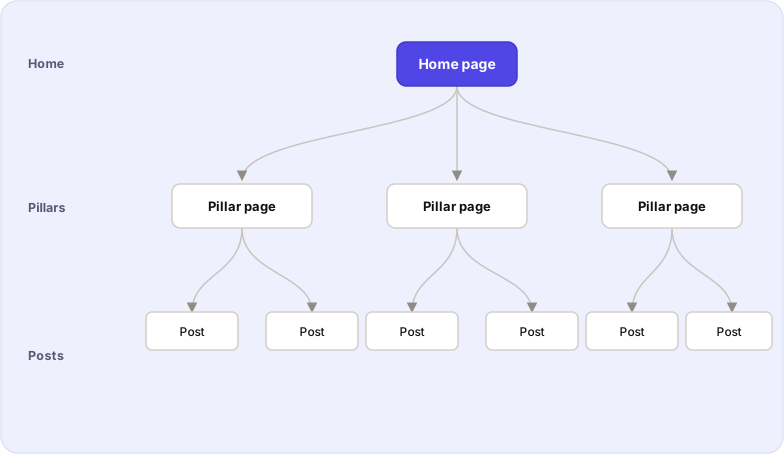
This shape does two things at once. It keeps the structure shallow, and it makes the relationships between pages legible — a search engine can see that a post belongs to a category, and that the category is a major section of the site. This is the same idea behind the authority that flows through a site, covered in how link equity flows through a site: a clean hierarchy lets value reach the pages that matter.
Topic clusters and pillar pages
A topic cluster is a way of organising content around a subject. It has two parts:
- A pillar page covers a broad topic at a high level. This guide’s parent, the complete guide to internal linking for SEO, is a pillar page.
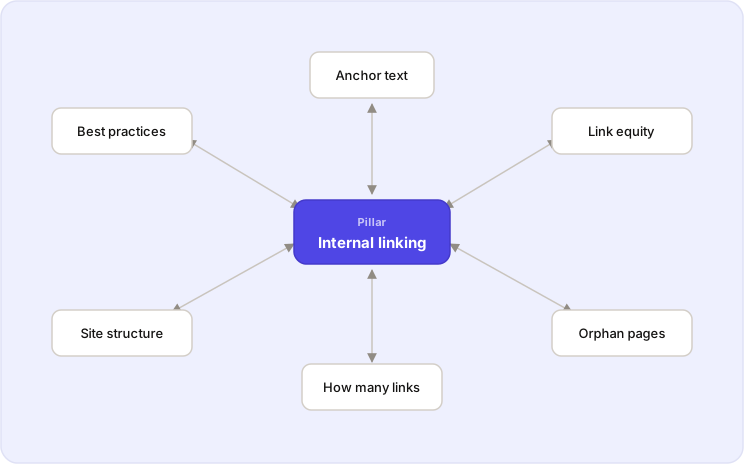
- Cluster pages each cover one part of that topic in depth — anchor text, link equity, orphan pages, and so on.
The pillar links down to each cluster page, and each cluster page links back up to the pillar. That reciprocal linking is what makes it a cluster rather than a list. It signals to a search engine that you cover the topic comprehensively, and it gives a reader a coherent path through it.
Silos and clusters
Two terms describe related but distinct ideas, and they are often confused.
A silo is about URL and folder structure — grouping related pages under a shared path, such as /seo/, /seo/keyword-research/, and /seo/link-building/. It organises pages by address.
A topic cluster is about the linking network — which pages link to which, regardless of their URL path. It organises pages by relationship.
You do not have to choose. Most well-structured sites use a clean URL structure and a cluster linking model together. What is worth avoiding is a strict silo that forbids linking between sections: walling off your content means related pages never link to each other, and you lose both the reader’s path and the authority that would have flowed across. Use structure to organise, and let relevant links cross section boundaries where they genuinely help.
How to plan your structure
You do not need to rebuild a site to improve its structure. A few steps cover most of the work.
Map your topics. Group your existing content by subject. The groups are your candidate clusters.
Identify or create a pillar for each. For each group, decide which page is the broad, definitive one — or write it if it does not exist yet.
Link the cluster together. Point each cluster page up to its pillar, and the pillar down to each cluster page. Use descriptive anchor text on every one, so the links describe the relationships as well as create them.
Keep it shallow. Make sure important pages are reachable in a few clicks, and that nothing significant is stranded deep in the structure.
Use taxonomy deliberately. In WordPress, categories and tags are structure. Filing posts under coherent categories and meaningful tags helps both readers and search engines see how your content relates — provided the taxonomy reflects real topics rather than an uncontrolled sprawl of tags.
Common structural mistakes
A few patterns undo good structure, and they are worth watching for.
Flat everything. A site where every page hangs directly off the home page has no hierarchy for a search engine to read, and no way to signal which pages are the important ones. Some structure is better than none.
Orphaned sections. A whole cluster can end up disconnected if its pillar is never linked from anywhere prominent. Finding these is the job of how to find and fix orphan pages.
Structure by navigation alone. If a page is reachable only through a menu or a sidebar widget, it loses its place in the structure the moment that template changes. Body links in your content are what hold a structure together over time.
Over-tagging. Creating a new tag for every post produces dozens of thin archive pages that dilute the site rather than organise it. Keep the taxonomy small and meaningful.
Checking whether your structure actually holds — whether pages are orphaned, underlinked, or buried too deep — is the work of a full internal link audit.
Site structure in Core+ Links
Structure is central to how Core+ Links ranks internal link candidates. The heaviest of the eight ranking signals is taxonomy overlap, weighted at 0.30 — shared categories and tags — because two posts you have filed under the same category are strong evidence of a real relationship, stronger than shared words alone. A second signal, link-graph relevance, accounts for where a page already sits in your structure.
In other words, the tool reads the structure you have built and ranks suggestions in light of it, rather than treating every page as an isolated bag of words. It runs on your own WordPress install, deterministically, and sends nothing off-site.
Try it on your own site — download Core+ Links Free.
Read the ranking model
The eight signals, renormalisation, and the overlinked penalty — in the docs.