5 min read
Anchor text for internal links
Anchor text is a small thing that does a large amount of work. It is the visible, clickable part of a link, and it is one of the clearest signals you can send about what a page is about — to a reader deciding whether to click, and to a search engine deciding what the destination covers.
This article is about anchor text for internal links specifically: what it is, why it matters, the forms it takes, and how to write it well. It is one part of the complete guide to internal linking for SEO.
What anchor text is
Anchor text is the clickable words of a hyperlink. In HTML, it is the text between the opening and closing anchor tags:
<a href="/link-equity/">how link equity flows through a site</a>Here the anchor text is “how link equity flows through a site”. A reader sees those words; a search engine reads them as a description of the page the link points to.
Why anchor text matters
Anchor text gives context. Google’s guidance on crawlable links is explicit that good link text helps it understand what the linked page is about — and it recommends writing descriptive text rather than generic phrases.
For a reader, descriptive anchor text sets an expectation before the click: “our guide to keyword research” tells them exactly where they are going. For a search engine, it is a labelled signal about the destination’s topic. An anchor that reads “click here” gives neither a reader nor a search engine anything to work with. It is a wasted opportunity on every link where it appears.
Because internal links are ones you place and control entirely, they are the easiest place to get anchor text right — and the most common place it is neglected. The anchor also plays a part in how link equity is read: a relevant, descriptive link between two related pages is more useful than a vague one between unrelated pages.
The forms anchor text takes
You will encounter a few kinds, and it helps to name them.
Descriptive anchors name the destination in natural language: “how to find and fix orphan pages”. These are the ones to aim for.
Exact-match anchors are the target’s keyword verbatim: “orphan pages”. Fine in moderation, and natural when the keyword genuinely fits the sentence.
Partial-match anchors contain the topic within a longer phrase: “dealing with orphan pages on a large site”.
Branded anchors use a product or site name: “Core+ Links”.
Generic anchors say nothing about the destination: “click here”, “read more”, “this post”. These are the ones to avoid on any link that matters.
Naked URLs show the address itself: “/blog/link-equity/”. Occasionally useful, rarely ideal as body-content anchor text.
How to write internal anchor text well
A few habits cover most of it.
Name the destination. The anchor should describe what the reader will find. If you removed the surrounding sentence, the anchor alone should still hint at the target.
Keep it concise. A few descriptive words are enough. A whole sentence wrapped in a link is hard to read and dilutes the signal.
Front-load the meaning. Put the descriptive words in the anchor itself, not in the text around it.
Vary your anchors naturally. Linking to the same page with identical anchor text every time reads mechanically. The same destination can be reached from “internal linking strategy”, “planning your internal links”, and “how to structure internal links”, each fitting its own sentence.
Stay relevant. The anchor and the destination should match. An anchor that promises one thing and leads to another erodes trust and confuses the signal.
A worked example
Take a single sentence and watch the anchor do the work. Written poorly:
We wrote about improving your site’s structure. To learn more, click here.
The reader learns nothing from the link, and neither does a search engine. Now written well:
A shallow hierarchy helps authority reach your key pages — see site structure and topic clusters for how to plan one.
Same link, same destination. The second version tells the reader exactly what they will get, describes the target to a search engine, and reads naturally in the sentence. Nothing about it is more work than “click here” once it is a habit — which is the point.
A note on over-optimisation
It is possible to overthink this. Repeating the exact-match keyword as the anchor on every internal link, regardless of how it reads, produces robotic text that serves the keyword rather than the reader.
Internal anchors carry less risk here than external ones, because you control the whole context and a search engine expects your own site to link to itself. Still, the goal is the same as the rest of good internal linking: write for the reader first, and the signal takes care of itself. If an anchor reads naturally and describes where it goes, it is doing its job.
Reviewing anchor quality across a site is one part of a full internal link audit — it is the check most often skipped, because generic anchors are invisible until you go looking for them.
Anchor text in Core+ Links
When Core+ Links suggests an internal link in the block editor, you choose the anchor text as you insert it. The suggestion identifies the relevant destination and its match score; you decide how to phrase the link so it fits the sentence and describes the target. The insertion is one action, and the anchor is yours to write rather than generated for you.
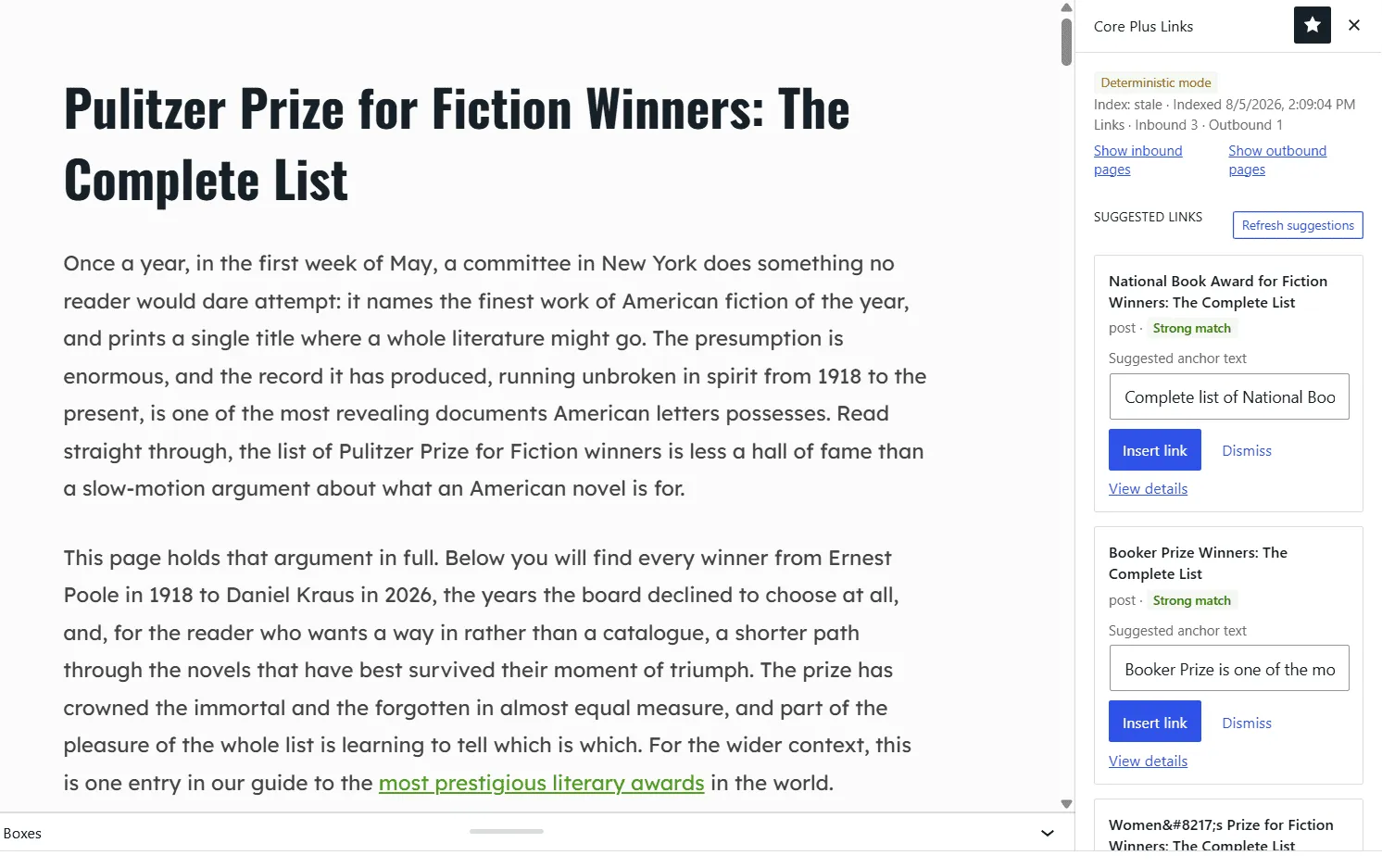
The suggested anchor text is editable — you name the destination before inserting the link.
Because the suggestion already tells you what the destination is about — and shows the signals behind the match — writing a descriptive anchor is a matter of naming what you are linking to, not guessing at it. The tool runs entirely on your own WordPress install, deterministically, and sends nothing off-site.
Try it on your own site — download Core+ Links Free.
Read the ranking model
The eight signals, renormalisation, and the overlinked penalty — in the docs.