6 min read
Link equity, explained
Link equity is one of those SEO terms that gets wrapped in more mystique than it deserves. Underneath the jargon is a simple idea: a link passes some of one page’s authority to another. Understanding how that works, and where it stops being measurable, is enough to make better decisions about which pages on your site link to which — and it sits at the centre of the complete guide to internal linking for SEO.
This article covers what link equity is, how it moves through a site, what affects how much passes, and how to direct it toward the pages that need it.
What link equity is
Link equity is the ranking value that one page passes to another through a link. You will also see it called “link juice” — the same idea, less formally.
The concept comes from PageRank, Google’s original method of measuring a page’s importance by the links pointing to it. Google has confirmed on the record that PageRank remains one of the many signals it uses to rank pages. Every link — internal or external — can carry some of this value from its source page to its destination.
For internal linking, the useful part is this: the authority your site earns, whether on the home page or on a post that attracted external links, does not have to stay where it landed. You can move it around your own site by choosing what links to what.
How link equity flows through a site
Think of authority as something that enters your site at a few strong points and then spreads along your internal links.
Your home page usually carries the most, because it tends to attract the most external links. When it links to a category page, some of that value flows through. When the category links to an individual post, more flows again. A page with many inbound internal links from strong pages accumulates more equity than a page linked from nowhere.
This is why site structure and topic clusters matter so much. A shallow, well-connected structure lets equity reach your important pages in a click or two. A deep or broken structure leaves value stranded near the top and pages at the bottom starved of it.
A page with no inbound internal links at all — an orphan page — receives no internal equity, because there is no link to carry any. That is one of several reasons orphan pages are worth finding and fixing.
What affects how much equity passes
A link is not a fixed-size pipe. Several things change how much value moves through it.
The number of links on the source page. The equity a page can pass is divided among its outbound links. A page with a hundred links passes a fraction through each; a page with a handful passes more through every one. This is the dilution principle, and it is the reason how many internal links a page has is worth thinking about.
Whether the link can be followed. A link a search engine cannot crawl, or one marked nofollow, does not pass equity the way an ordinary followed link does. Keep internal links as real, followable <a href> links.
Placement and prominence. A prominent link in the main content tends to be weighted more than one buried in a footer, in line with the way search engines model how likely a link is to be clicked.
Relevance and anchor text. A link between two topically related pages is more useful, to both readers and search engines, than one between unrelated pages — and the anchor text that describes the destination is part of how that relevance is read.
A worked example
Suppose you publish a definitive guide to a topic and it earns a dozen external links over a year. It is now one of the strongest pages on your site. Elsewhere, you have three older posts on the same topic that never attracted links of their own and sit several clicks deep.
Left alone, the guide’s authority mostly stays with the guide. Add a contextual link from the guide to each of the three older posts, and some of that authority now flows to them — and because the posts are topically related, the links are useful to readers arriving on the guide as well. You have not created authority from nothing — you have directed what you already earned toward the pages that had none. That is the whole of the practice.
How to direct link equity where it helps
The practical goal is to move authority toward the pages that need it and away from wasting it.
Link from your strong pages to your important ones. Identify the pages that have earned the most external links, and add internal links from them to the newer or important pages you want to strengthen. This channels authority where you need it most.
Fix the pages getting none. Orphan pages receive no internal equity, and underlinked pages receive less than their importance warrants. Both are surfaced by a full internal link audit.
Do not pile more onto pages that already have plenty. Adding a tenth inbound link to a page that is already well connected does less than adding the first inbound link to a page that has none. Spread equity toward what needs it rather than concentrating it where it is already abundant.
The honest limit
Here is where restraint matters. You cannot see the exact amount of equity a page holds or passes. The internal PageRank figures that some tools report are estimates built from your link graph, not numbers Google publishes. They are useful for spotting which pages are relatively strong or weak, and not for anything more precise than that.
And directing equity toward a page does not guarantee it will rank better. Link equity is one signal among many, and no one can honestly promise that redistributing it will move a specific ranking. What you can say is true is narrower and still worth acting on: a page with relevant inbound internal links from strong pages is better placed to be discovered, crawled, and understood than a page with none.
Link equity in Core+ Links
Two parts of Core+ Links relate directly to how equity moves through your site.
One of the eight ranking signals is link-graph relevance — where a candidate page sits in your existing internal link structure — so suggestions account for how your site is already connected rather than treating every page in isolation.
There is also a penalty applied after the weighted score: a page that is already heavily linked scores lower as a suggestion than one that is not. The intent is exactly the point of this article — to spread links toward the pages that need them, rather than onto whatever is already well connected. The underlinked report names those pages directly.
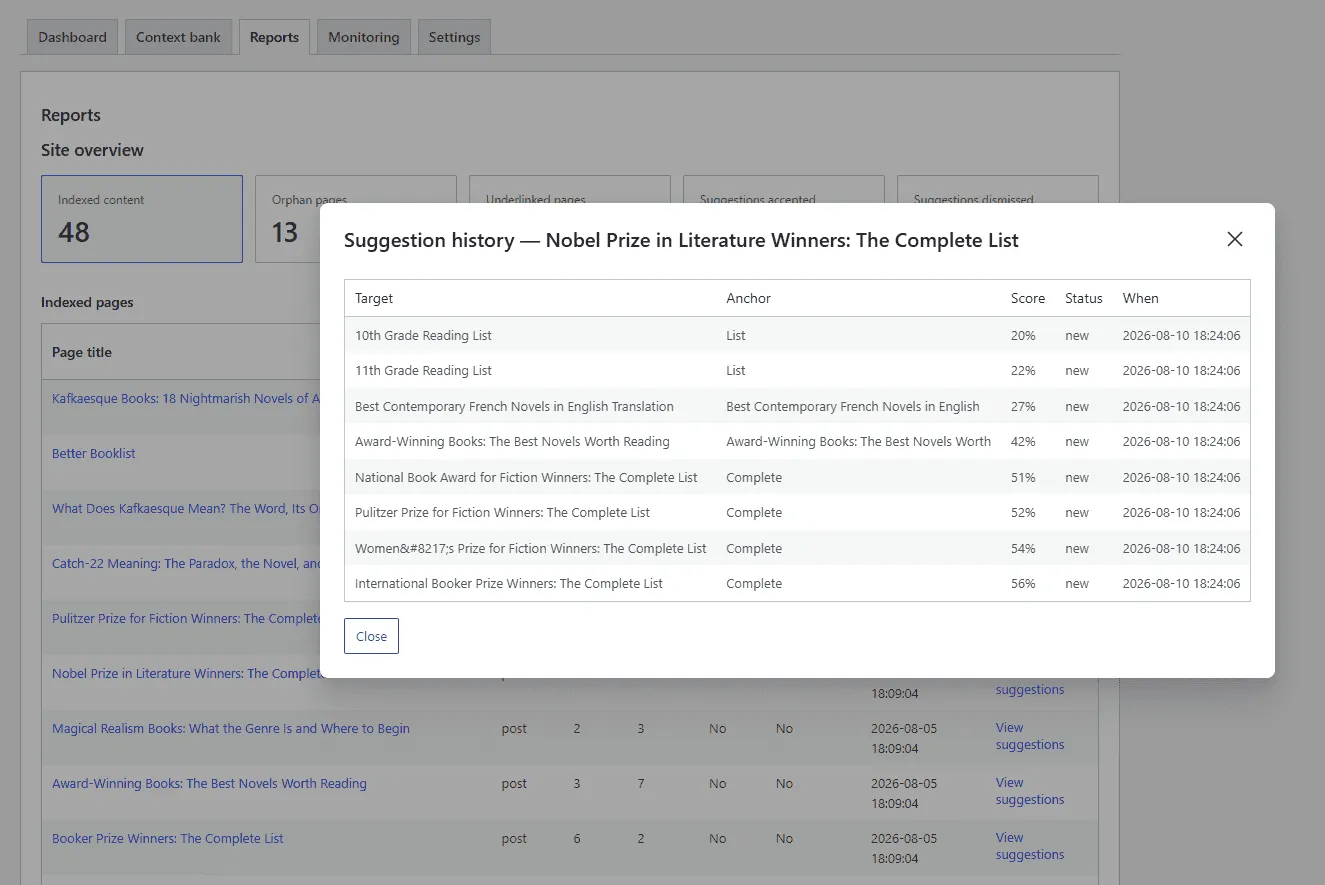
The reports show inbound and outbound link counts per page, so underlinked pages are named directly.
Everything runs on your own WordPress install, deterministically, and sends nothing off-site.
Try it on your own site — download Core+ Links Free.
Read the ranking model
The eight signals, renormalisation, and the overlinked penalty — in the docs.